
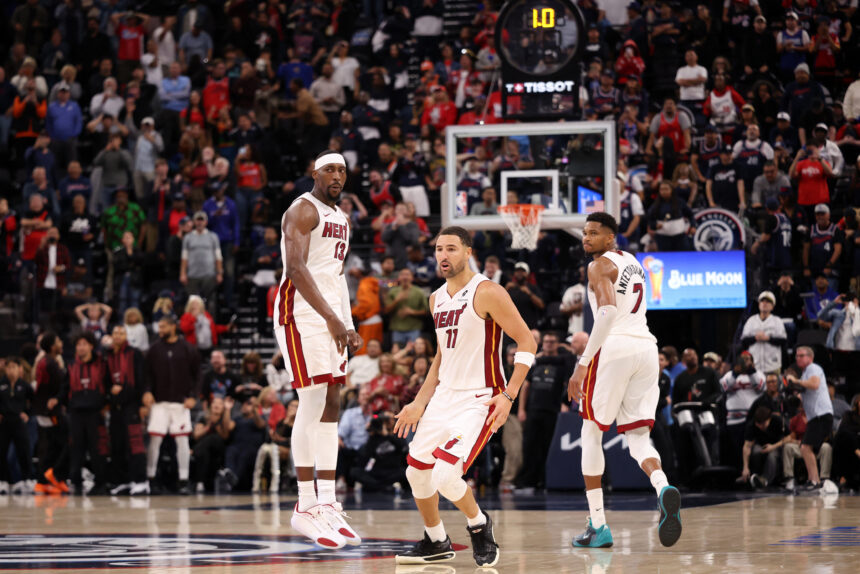
Giannis Antetokounmpo says the Miami Heat can create an opening against a defense before either he or Klay Thompson takes a shot.
The problem for opponents, as Antetokounmpo explained after Saturday’s win over the Detroit Pistons, is deciding which threat deserves their attention.
Staying attached to Thompson leaves less help available against Antetokounmpo. Moving toward Antetokounmpo risks giving Thompson the space he needs on the perimeter.
“It’s like a malfunction. Whoever is guarding Klay, can’t leave him. Whoever is guarding me, can’t leave me,” Antetokounmpo said.
I talked to Giannis Antetokounmpo about some specifics of attacking with Klay Thompson a pass away:
“It’s like a malfunction. Whoever is guarding Klay, can’t leave him. Whoever is guarding me, can’t leave me.”
More: pic.twitter.com/dgEOFKj3Hr
— Brady Hawk (@BradyHawk305) November 15, 2026
That explanation offers a more useful look at their developing partnership than another compliment about Thompson’s shooting. Antetokounmpo is describing a decision the Heat can force, then exploit before the defense has time to recover.
Miami beat Detroit 137-117 for its fourth consecutive victory, improving to 7-6. Antetokounmpo finished with 34 points, 14 rebounds and eight assists, while Thompson contributed 26 points and six 3-pointers.
The Heat opened the season with four losses before winning seven of their next nine games. That puts the discussion in a different setting from the opening week, when Miami was still looking for its first victory with its new group.
For a team still establishing how its offensive pieces fit together, the value is in having more than one way to finish the same action. Thompson can be the scorer, but the attention he commands also gives Antetokounmpo a chance to make the next read.
Giannis describes the opening Klay Thompson creates
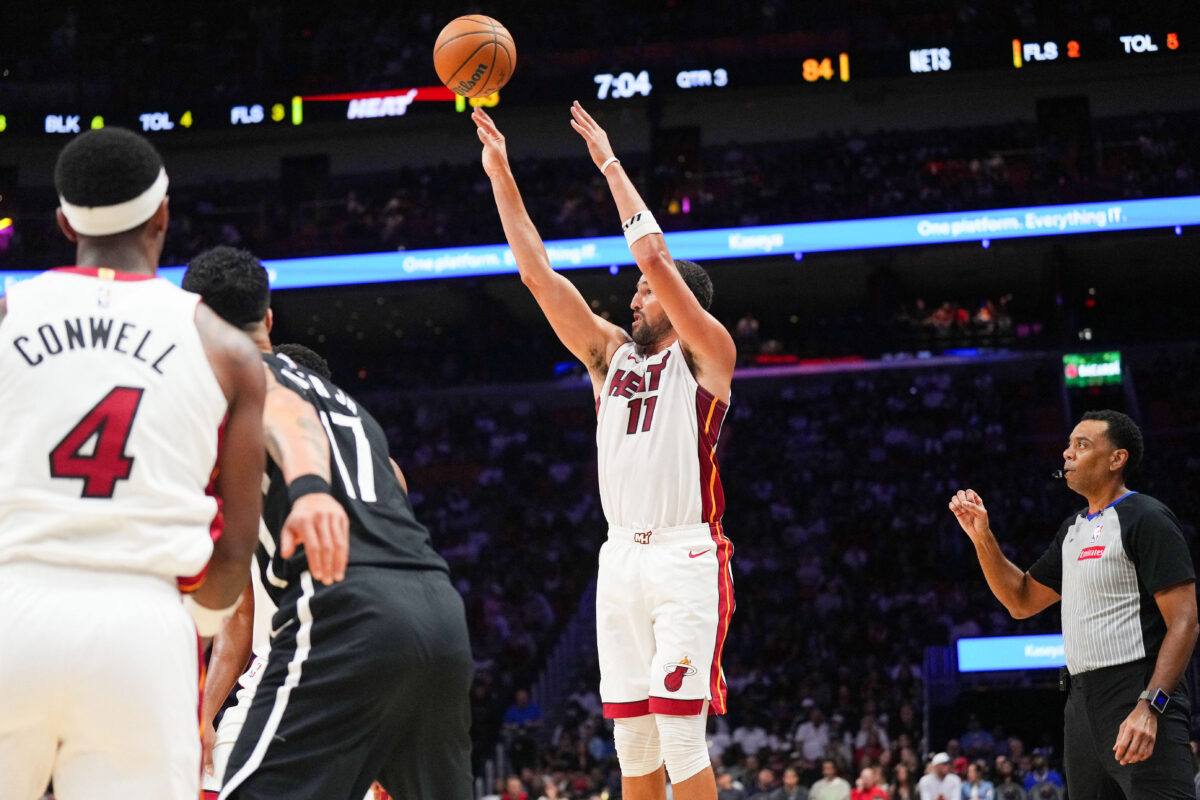
Antetokounmpo’s explanation continued beyond the initial hesitation. He described a brief decision-making window, with Thompson’s movement allowing Miami to pursue a shot, a curl toward the basket or a pass that takes advantage of help elsewhere.
The distinction is between using Thompson as a stationary destination and involving him in the action that creates the advantage. In Antetokounmpo’s description, the defender’s responsibility to Thompson affects what happens around the ball, even when Thompson is not the player who ultimately scores.
That makes the timing of the pass important. An opening created by hesitation is temporary; the offense has to recognize it while the defender is still choosing how to respond.
Antetokounmpo’s account puts the emphasis on that immediate read, rather than on a predetermined finish. It also explains why the partnership should be evaluated beyond the number of passes that become Thompson baskets.
A possession can benefit from his involvement even if the ball goes somewhere else. The useful question is whether the defense has been forced to move and whether Miami takes advantage of that movement.
Those are possibilities described by Antetokounmpo, not a claim that every combination involving the two has already become efficient. Saturday’s scoring gives the discussion a concrete result, but it does not establish how opponents will handle the same actions over a longer stretch.
Thompson’s response puts the focus on Giannis’ passing
Thompson offered his own explanation of what makes the partnership valuable after the game. He praised Antetokounmpo’s ability to combine scoring and rebounding with a substantial playmaking contribution, then described the benefit of being one of his targets.
“He can be the best player in the world, man. I’m lucky to be on the receiving end of that,” Thompson said.
“Oh, it's incredible. He's so special. I mean, Giannis gets 35 and 10 like it's nothing, and when he throws in 7, 8, 9 dimes, he can be the best player in the world, man. I'm lucky to be on the receiving end of that,” Klay Thompson on Giannis #Heat pic.twitter.com/AY0k3cS1cX
— Zachary Weinberger (@ZachWeinberger) November 15, 2026
The comments approach the same relationship from opposite sides. Antetokounmpo sees Thompson’s defender as someone who cannot freely move toward him. Thompson sees a teammate capable of delivering the ball when that attention creates a chance to score.
Thompson shot 10-of-17 overall and 6-of-11 from 3-point range in 20 minutes. That production made his return particularly valuable after the ankle issue covered in Miami’s pregame injury report.
His shooting line also gives the partnership a practical measure for this game: Miami received a substantial scoring contribution without needing Thompson to play extended minutes.
It does not tell us which baskets came from each type of action, so the performance should not be treated as a statistical breakdown of the specific sequence Antetokounmpo described.
The partnership fits Miami’s broader offensive adjustment
There was already evidence before Saturday that Miami was finding different ways to involve its shooters and big men together.
A Nov. 12 report showed the Heat using 12 dribble handoffs per 100 possessions this season, compared with six last season. The report identified Thompson’s work with Antetokounmpo and Bam Adebayo as part of that change.
There’s also been an increase in pick-and-roll usage after Miami’s opening four losses. Those figures describe different comparisons.
The handoff numbers compare seasons, while the pick-and-roll change concerns separate stretches within this season. Neither should be presented as a measurement of the Giannis-Thompson pairing alone.
They do, however, establish that the Heat’s search for useful combinations extends beyond a single postgame observation. Miami has been adjusting the way it initiates possessions as its players learn where their teammates can be effective.
Davion Mitchell previously explained that the offensive changes still leave room for Miami to play quickly. More organization on selected possessions does not require the Heat to wait for a ball screen every time down the floor.
Antetokounmpo’s latest comments give that broader discussion a specific example. The purpose of involving Thompson is not simply to add another step to a possession.
It is to make two defenders account for two different threats at the same time, then identify the opening before it disappears. Miami’s next task is to reproduce that decision-making against different coverages.
Saturday provided an encouraging result, and Antetokounmpo supplied a clear explanation of what he sees when Thompson is nearby.