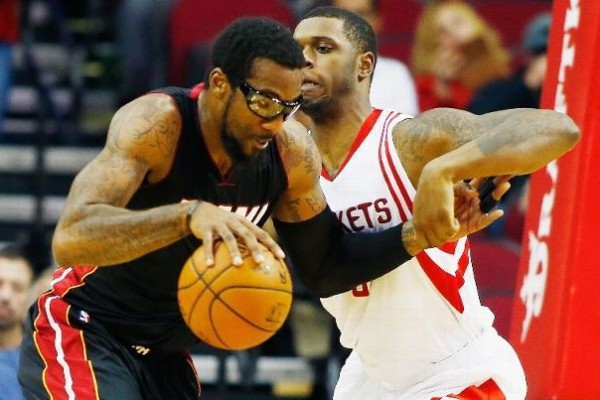
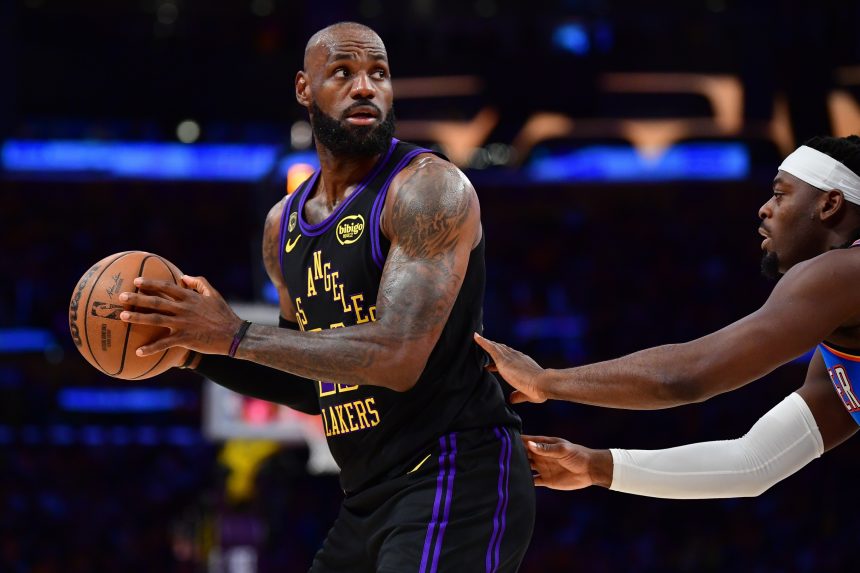
The 2026 NBA Summer League tipped off Thursday in Las Vegas, and of the three franchises most often named in LeBron James’ free agency, only one arrived with its roster already finished. That is the Miami Heat’s whole problem.
Cleveland has spent the month doing nothing on purpose. Philadelphia made its swing in June and has been filling the edges since.
Miami traded four rotation players for Giannis Antetokounmpo, watched its best shooter leave and now holds one meaningful tool, which it cannot use twice. Thursday brought reporting explaining why James is under no pressure to decide. Nobody has said the same about the team waiting on him.
No penalty for him; that is not the same as no penalty for Miami.
Brian Windhorst, who has covered James for the better part of two decades, laid out the mechanics during a Yahoo! Sports appearance.
“He can join a team in December,” Windhorst said.
The logic is structural. Because James is not chasing a maximum contract, none of the usual clocks apply — no cap-space window closing, no rival forcing his hand. Windhorst likened it to a veteran NFL player sitting out the opening rush, letting the market settle and signing once the picture clarifies.
He believes James already has a preference. He simply has no reason to say it out loud. Every team in the running absorbs that differently, and Miami absorbs it worst.
Cleveland has been deliberately quiet, entering the month with three open roster spots — one earmarked for James Harden, one held for James himself.
Waiting is not free for the Cavaliers either; they committed $273 million to a Donovan Mitchell extension this week and may need to move salary to create room. But their wait costs them nothing they were going to use anyway. Philadelphia is in a similar position, having spent its capital on Jaylen Brown before James was ever a live option.
Miami spent first and got told to wait afterward.
Why 2026 is not 2014 for the Heat
The Heat have been on this end of a LeBron James free agency before, and it ended badly. James let the process run until July 11 that summer before returning to Cleveland, and Miami spent the following days reassembling a Finals roster in a hurry, adding Danny Granger, Josh McRoberts and Luol Deng while re-signing Dwyane Wade, Chris Bosh, Udonis Haslem and Chris Andersen.
The structure has inverted. In 2014, rejection meant scrambling to replace a departing superstar with money the Heat still had. In 2026, the superstar is already in the building and the money is already gone.
Miami sent Tyler Herro, Kel’el Ware, Jaime Jaquez Jr. and Kasparas Jakucionis to Milwaukee for Antetokounmpo and Bobby Portis, then watched Norman Powell agree to terms with the Chicago Bulls before adding Tim Hardaway Jr.
Rejection this time would not produce a scramble. There is nothing left to scramble with.
Where the Heat actually sit
The reporting has consistently placed Miami inside the lead group without placing it in front. Shams Charania, discussing the field on ESPN’s “Get Up,” described the Cavaliers and Heat as the two familiar destinations while noting that Philadelphia’s Brown acquisition forced its way onto James’ radar.
“The Cavaliers, the Heat, they’re two teams that are known quantities,” Charania said, in ESPN’s running free-agency file.
By Tuesday he had narrowed it to Cleveland, Miami and Philadelphia. The people closest to it keep landing in the same place, though. Windhorst has said the feel around the league tilts toward Cleveland, and NBC Sports reported Thursday that league sources reading the tea leaves believe James is going back, while cautioning that his camp has kept the process unusually closed.
Chris Haynes reported that Rich Paul intends to take the meetings himself and brief his client afterward, which removes the one event that normally signals a decision is near. Nobody gets a room with James. Nobody gets a tell.
Miami’s market position has softened rather than firmed over the past week, something we tracked as the betting boards moved north toward Ohio.
What the waiting actually costs
What follows is analysis rather than reporting. No beat writer has described the Heat’s internal contingency planning, and none of it should be read as an account of what Pat Riley intends to do.
The first thing to understand is that Miami is not weighing whether to accept a hard cap, because it already has one. The Heat are listed among the teams operating under a first-apron hard cap for 2026-27, triggered by the expanded trade exception used to acquire Antetokounmpo, per Yossi Gozlan’s apron tracker at Sports Business Classroom.
That apron sits at $195,945,000, and once a team trips it, the figure becomes an absolute ceiling that cannot be crossed under any circumstance for the remainder of the league year.
That reframes what Miami is actually able to offer. The ceiling on a James contract is not set by the face value of the mid-level exception, which is the number most of the national conversation has been working from, but by whatever distance remains between the Heat’s payroll and the apron — a gap that narrows with every roster spot Miami fills while the decision stays open.
Windhorst’s point sharpens the bind from the other end, because if nothing penalizes James for waiting, no date arrives at which the Heat can declare the pursuit finished and redirect what is left. Cleveland’s open roster spots function as an asset for as long as this lasts, whereas Miami’s remaining room survives only in the sense that nobody has yet made it disappear.
The 41-year-old at the center of it
It is worth being precise about who Miami is holding anything for. James turned 41 in December and will be 42 before the 2026-27 postseason begins.
He averaged 20.9 points, 6.1 rebounds and 7.2 assists per game across 60 appearances last season while shooting 51.5 percent from the field and 31.7 percent from 3-point range, per Basketball-Reference. That scoring figure matches his rookie-year average and stands as the lowest of his 23 seasons. The 3-point mark is his worst since 2015-16.
The counterweight is that he remains a full-time creator. Across 1,622 regular-season games he has averaged 26.8 points, 7.5 rebounds and 7.4 assists per game, and he spent four seasons in Miami producing 26.9 points per game while winning back-to-back titles and Finals MVP honors in 2012 and 2013. Next to Antetokounmpo and Bam Adebayo, he would not need to carry an offense. He would need to organize one.
What to watch next
The Heat play out their Vegas schedule this week with only two players on the Summer League roster under NBA contract, which means Miami’s real business happens in hotel lobbies rather than the Thomas & Mack Center.
One date on the horizon does not depend on James at all: Six months after the Antetokounmpo trade is finalized, Antetokounmpo becomes eligible to sign a four-year, $275 million maximum extension.
Riley has already won the offseason. Whether he wins the summer belongs to a man with no reason to tell him.