
Pelle Larsson believes the Miami Heat’s defensive problems include players being too reluctant to take responsibility around their teammates.
With Miami entering Monday’s game against the Dallas Mavericks at 0-3, Larsson described a team whose consideration for one another has become hesitation on the court.
His assessment offered a specific problem to address as the Heat try to turn their individual defensive ability into better collective results.
“We’ve been too careful with each other, and tiptoeing around each other a little bit, waiting for the next guy to make the play,” Larsson said. “Just got to have a little bit more aggressiveness.”
Larsson acknowledged the adjustment required when so many teammates are new. But he also argued that respecting those teammates should mean fulfilling his own responsibilities, rather than leaving room for someone else to act.
That puts the emphasis on decisions Miami can change immediately, even while its chemistry remains a work in progress.
Heat’s defensive concerns preceded their winless start
The issue Larsson identified did not emerge only after three regular-season losses. As Heat Nation covered before the opener, Davion Mitchell had already raised concerns about Miami’s defenders trusting teammates to handle assignments without providing enough support.
That earlier warning gives Larsson’s comments added significance. The Heat are dealing with a problem players recognized before the results began counting, rather than searching for an explanation created entirely by the record.
The distinction also matters when evaluating what improvement should look like. A better final score alone would not establish that the underlying coordination had improved.
Miami needs the help to arrive consistently, including on possessions that begin with one of its better defenders matched against the ball.
Erik Spoelstra’s response to Saturday’s loss in Charlotte raised a related question about sustaining activity. After the Heat rallied late, the coach challenged their effort across the game.
“We have to be able to sustain that level of effort and focus and discipline for 48 minutes,” Spoelstra said.
Larsson’s explanation now adds a player’s account of the hesitation behind that broader concern.
Bam-Giannis numbers show the problem and the limits of early conclusions
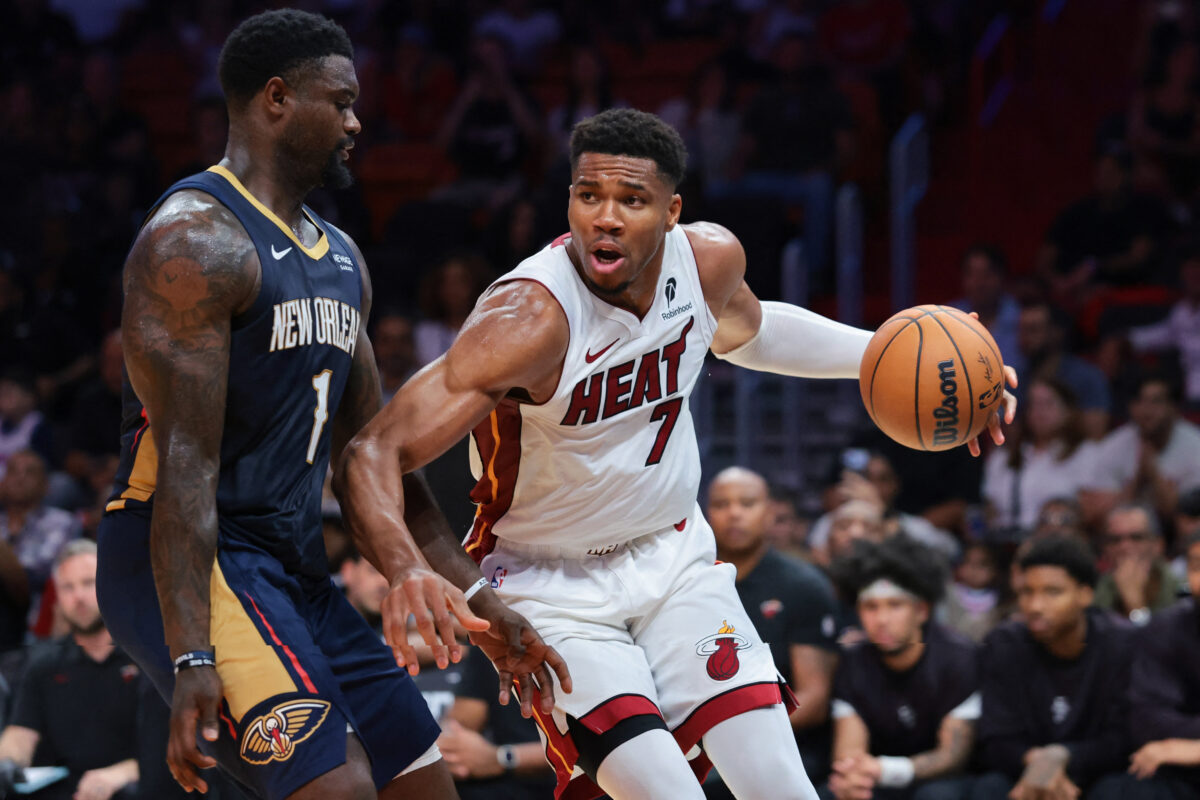
In his Monday analysis, NBA.com’s John Schuhmann listed Miami 27th defensively, allowing 121.4 points per 100 possessions through its first three games of the 2026-27 regular season.
The breakdown by frontcourt combination was more revealing:
| Frontcourt combination | Minutes | Points allowed per 100 possessions |
|---|---|---|
| Bam Adebayo and Giannis Antetokounmpo together | 50 | 136.0 |
| Exactly one of Adebayo or Antetokounmpo | 81 | 113.2 |
Those results show how far the shared minutes have been from Miami’s intended defensive identity. They do not establish that the pairing cannot work: Opponents shot 24-of-46 from 3-point range with both stars playing, a rate of roughly 52 percent over a small sample.
That shooting provides an important qualification, not an explanation for every breakdown. The numbers cannot identify which mistakes came from hesitation, and Larsson’s comments cannot establish how much of the scoring will disappear as opponents’ shooting changes.
Both deserve attention without treating either as the whole answer. Miami’s offense also ranked 27th, producing 105.1 points per 100 possessions.
That leaves the Heat with problems at both ends, rather than an otherwise efficient team being undone by one weakness. Defensive improvement would reduce the burden on an offense that has not yet demonstrated it can consistently compensate for so many points conceded.
Larsson helped provide a different response in Charlotte
Larsson’s place in this discussion extends beyond his comments. He contributed 15 points and seven rebounds in Saturday’s 115-110 defeat.
Mitchell finished with 22 points and 10 assists, while Adebayo supplied 20 points and eight rebounds. Those performances gave Miami production from multiple players during a loss in which Antetokounmpo finished with 14 points and six rebounds.
Larsson was among the contributors who gave the Heat a chance to recover, rather than simply waiting for their newest star to rescue the game.
Miami opened the four quarter with a 25-4 run to tie the score at 100. The group included Larsson, Mitchell, Adebayo, Bobby Portis Jr. and Tim Hardaway Jr., with Antetokounmpo on the bench.
That stretch is useful evidence for Spoelstra because it identifies a combination that produced a response within the same game. It gives the coaching staff something concrete to review when asking for better participation from the supporting cast.
It is a much narrower finding than declaring the starting lineup wrong or prescribing a permanent rotation change. A successful stretch with one group does not isolate the contribution of each player, and it cannot establish what that unit would do over longer minutes against different opponents.
For Larsson, the immediate relevance is that his call for more initiative follows a game in which he helped provide some himself.
Mitchell faces a related balancing act on offense
Responsibility is also being sorted out with the ball. Mitchell’s effort was balance with attacking while getting teammates involved.
Mitchell explained that teammates can lose their offensive rhythm when possessions pass without opportunities for them. Spoelstra, however, does not want the guard’s search for that balance to eliminate his aggression.
“We don’t want him to not be aggressive,” Spoelstra said.
The competing demands help explain why Miami’s adjustment involves more than deciding which player should have the ball most often.
Mitchell must create openings without overlooking teammates, while those teammates must stay involved without assuming someone else will make every decision.
That offensive challenge is distinct from Larsson’s defensive criticism, but both concern how players share responsibility.
Against Dallas, Miami has an opportunity to begin answering those questions through its play, with Larsson calling for greater initiative from a group still learning how to function together.