

Erik Spoelstra saw enough during the Miami Heat’s comeback in Charlotte to make their third straight loss especially frustrating.
The activity he wanted was there for a stretch, but the Heat had already spent too much of Saturday night allowing the game to move away from them.
After the 115-110 defeat left Miami 0-3 for the first time since 2007, Spoelstra challenged his players to deliver that level of engagement before they needed a rescue mission. His message went beyond asking a newly assembled team for patience.
Coach Spo looks like he’s on the verge of tears
“Right now, we need inspiration” 😭 pic.twitter.com/wiREtMIZiX
— Heat Nation (@HeatNationCom) October 25, 2026
“Our system is our system,” said Spoelstra. “We can be that active at any point during the game. When we aren’t, we’re choosing not to, and we’re paying the price for that right now…and ultimately, what I told our team right now is we need inspiration.”
Spoelstra was discussing Miami’s ability to play with greater activity within its existing system. He also told the group it needed inspiration, pointing toward a comeback that briefly gave the Heat a chance to escape with their first victory.
The distinction matters for a team still learning to play around Giannis Antetokounmpo. Spoelstra was not describing every problem as something that must wait for chemistry to develop.
He was identifying a standard the Heat had demonstrated during the same game.
Heat’s fourth-quarter rally exposes their inconsistency
Miami opened the fourth quarter with a 25-4 run, turning a 96-75 deficit into a 100-100 tie. Mitchell scored the final five points of that stretch, but the Heat never moved ahead during the comeback.
| Stretch | Miami | Charlotte | Margin |
|---|---|---|---|
| First three quarters | 75 | 96 | -21 |
| Fourth quarter | 35 | 19 | +16 |
| Final | 110 | 115 | -5 |
The quarter-by-quarter split helps explain why Spoelstra could acknowledge progress without softening his criticism. Miami’s best period was strong enough to create a competitive finish, but it still had to overcome the damage from the preceding three.
The group that brought Miami back included Davion Mitchell, Bam Adebayo, Pelle Larsson, Tim Hardaway Jr. and Bobby Portis.
Antetokounmpo was on the bench during the surge, giving Spoelstra evidence that the supporting players could change the game without waiting for their leading star to carry every possession.
“We have to be able to sustain that level of effort and focus and discipline for 48 minutes,” said Spoelstra. “We had a pretty good start to the game. The second quarter was inconsistent.”
That combination of effort, focus and discipline is a broader demand than simply playing harder. A comeback can establish that a group has another level available while still leaving questions about how reliably it makes decisions when the score is close.
For Spoelstra, the useful takeaway is the response from that particular unit. It gives him a group to revisit and a performance to reference when demanding more consistent participation.
It does not establish that Miami has found a permanent closing lineup or that Antetokounmpo should be excluded from it.
Spoelstra also identifies a shot-selection problem
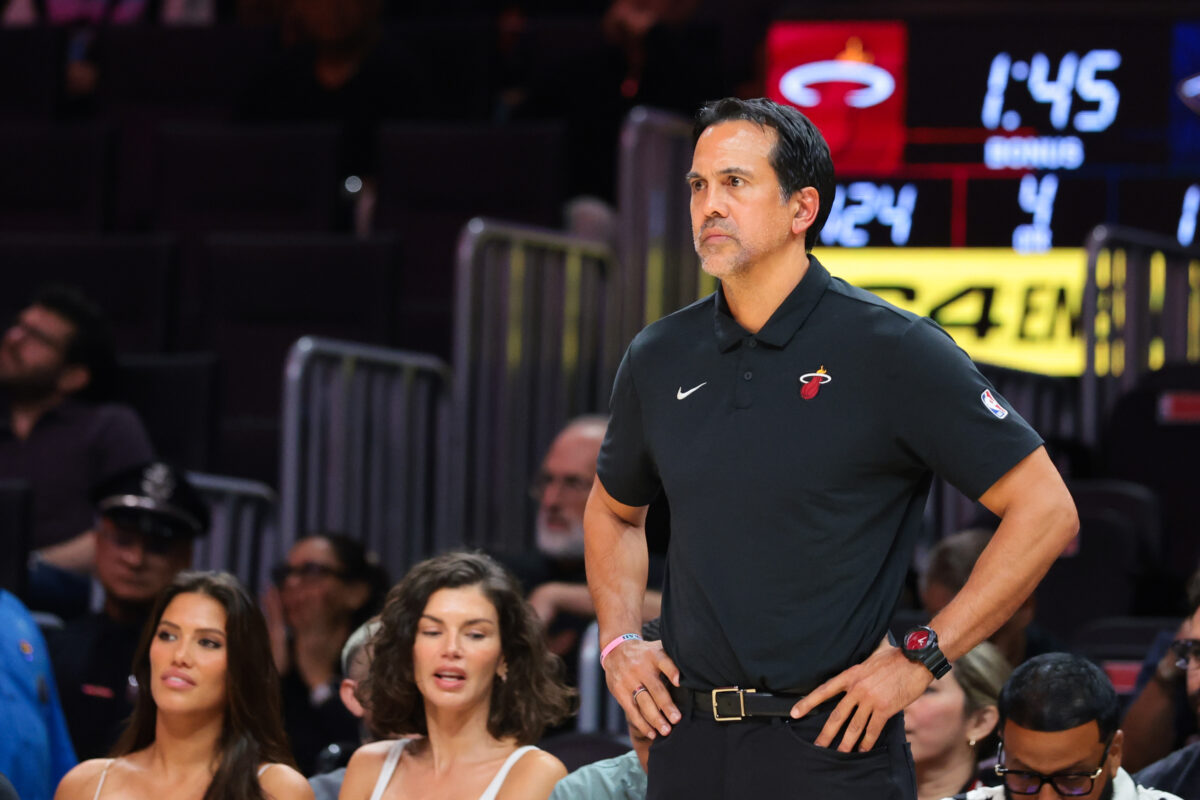
Spoelstra’s postgame assessment included criticism of Miami’s offensive choices. He identified roughly six to eight first-half possessions that ended with shots he did not want the Heat taking.
That is a separate issue from open attempts failing to fall. If Miami is creating the intended opportunity and missing, the response can be to keep generating that shot.
When the decision itself is wrong, repeating it does not solve the problem. The contrast with Friday’s loss to Detroit is notable.
As Heat Nation previously covered, Spoelstra defended the quality of several opportunities Miami created against the Pistons, even though the results were poor.
His Saturday comments show why the losses should not be treated as interchangeable. The same winless record can contain different problems, and the corrective work depends on identifying which possessions failed because of execution, selection or a missed opportunity.
The late rally also did not eliminate the cost of a mistake at the other end. After Miami drew even at 104, Grayson Allen converted a 3-pointer while being fouled, then completed the four-point play to put Charlotte ahead 108-104.
That sequence underlined the discipline portion of Spoelstra’s message. The Heat had worked their way back to a tie, only to surrender a possession worth four points in a game eventually decided by five.
Davion Mitchell responds to Miami’s 0-3 start
Mitchell offered a steadier assessment of the bigger picture after the loss.
“I mean, this is Game 3,” Mitchell said. “We’re not in panic mode. We’re going to figure it out.”
Mitchell finished with 22 points and 10 assists. Adebayo contributed 20 points and eight rebounds, while Larsson supplied 15 points and seven rebounds. Portis added 13 points and eight rebounds.
Those contributions give Miami something tangible to build on beyond the reassurance that the season is young. The comeback involved both starters and reserves, with several players contributing enough to prevent the game from becoming another comfortable defeat.
There is also a reason Mitchell’s confidence should not be read as satisfaction. Before the opener, he had already identified insufficient help between Miami’s defenders, explaining that individual ability did not remove the need for teammates to support one another.
Saturday’s response is therefore best viewed as a promising stretch within an unfinished process. It offers evidence of what the Heat can produce together without proving they have solved the consistency problem that Spoelstra raised.
Miami needs the response to arrive earlier
The Heat’s effort has been a subject of discussion throughout this opening stretch. After the Minnesota loss, Antetokounmpo accepted responsibility while calling for greater effort and trust.
Spoelstra’s latest assessment now brings the responsibility back to the group’s decisions across a full game. Miami’s next test is Monday at home against Dallas.
The immediate objective is straightforward: produce the engagement that fueled Saturday’s comeback while the game is still manageable, then preserve it through the possessions that decide the result.
Spoelstra has a response he can point to. What the Heat still need is a performance that does not depend on finding that response after falling so far behind.