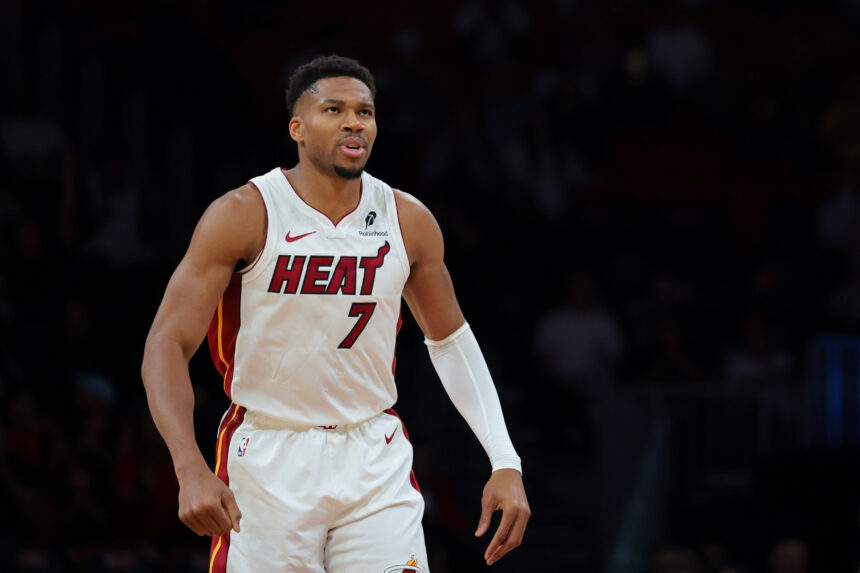
LeBron James sees plenty to like about the Miami Heat’s new look, and his assessment comes with a clear challenge for the pairing of Giannis Antetokounmpo and Bam Adebayo: Turn complementary skills into an offense that gives both players room to work.
Discussing Miami on Tuesday’s episode of “Mind the Game,” James pointed to the defensive personnel and Erik Spoelstra’s ability to organize it. His assessment included Adebayo, Antetokounmpo, Andrew Wiggins and Davion Mitchell.
“I think defensively they’re going to be damn good,” James said. “You look at Wiggins, Bam, Giannis, Davion Mitchell, guys they kind of hang their hats on. They’re going to be damn good. You have Spo there. He knows how to put the pieces in position, in the right place.”
James also sees Adebayo’s outside shooting helping Antetokounmpo.
That is the more interesting question behind the endorsement. Miami can put shooting around its two big men, but the offense will look different depending on whether Adebayo’s own defender follows him away from the basket.
The distinction matters when evaluating how much space Antetokounmpo actually has to attack.
Bam Adebayo’s attempts are a starting point
Adebayo shot a combined 2-of-5 from three in his first two 2026 preseason games.
Five attempts cannot establish how opponents will defend him over a season. They offer an early indication of where some of his shots are coming from, without settling whether that shooting will consistently pull a defender out of the paint.
For Miami, the useful measure will be what happens around those attempts. If Adebayo receives the ball outside and his defender stays close, Antetokounmpo has one fewer body waiting near the rim.
If the defender backs away, Adebayo needs to make that choice costly through a shot or by using the available room to start another action.
Those are different outcomes, and a shooting percentage alone will not explain which one the Heat are getting. Shot volume, the location of the defender and the speed of the next decision all belong in the evaluation.
There is also a role question. Asking Adebayo to take available threes can help the offense.
Building possessions that leave him waiting for the ball regardless of what the defense does could limit the other ways he contributes.
Spoelstra has described a broader role for Bam

As Heat Nation reported Sept. 30, Spoelstra has discussed possessions with Adebayo creating and Antetokounmpo working away from the ball.
“It’s about playmaking, it’s about cutting, it’s about Giannis sometimes playing off the ball and Bam making the play,” Spoelstra said.
That gives Miami another way to address the fit. Adebayo does not have to provide value exclusively by drawing a defender toward the three-point line.
Giving him responsibility for initiating an action can require that defender to react to the ball while Antetokounmpo moves into a scoring opportunity.
The same Sept. 30 report also detailed an early adjustment for Antetokounmpo. He described throwing a pass out of bounds during practice after anticipating that a teammate would be in a different spot.
That example makes the remaining work more concrete. The Heat need their players to recognize the same openings, particularly when the initial action changes.
Having two capable decision-makers is useful only if the movement around them makes the next pass available.
It also puts the preseason in perspective. A successful possession can show what Spoelstra wants to build, while a mistake can reveal an unfamiliar read.
Neither should be treated as a final judgment on a partnership still learning its responsibilities.
Miami has shooting support around its two big men
The perimeter additions give Spoelstra options beyond Adebayo’s development. Tim Hardaway Jr. with 224 made threes at 40.7 percent during the 2025-26 regular season. Klay Thompson made 202 at 38.3 percent.
That is 426 combined makes before either played this season for Miami. Their previous production provides a reason to take the supporting shooting seriously, although it does not tell the Heat how particular five-man groups will perform together.
Miami also has an established route to offense before a defense gets set. Transition accounted for 24.9 percent of the Heat’s possessions in the 2025-26 season, the highest share in Synergy’s 22 seasons of tracking.
That background connects the two sides of James’ assessment. If Miami’s defense produces opportunities to run, it can reduce the number of possessions that require an answer against a crowded half court.
It will still need those answers when an opponent gets back, so transition success and half-court progress should be evaluated separately.
Thompson’s arrival also came with an explicit competitive goal. At his August introduction, he described the chance to contend as central to his decision.
The roster construction still involves a tradeoff. Miami sent Tyler Herro, Kel’el Ware, Jaime Jaquez Jr. and Kasparas Jakucionis to Milwaukee in the deal that brought back Antetokounmpo and Bobby Portis, along with draft compensation going to the Bucks.
The relevant offensive distinction is between finishing an advantage and creating one. A shooter who converts a kickout can reward Antetokounmpo for drawing help.
Miami also needs ways to generate a quality attempt when the first drive or passing option is unavailable.
LeBron’s optimism leaves an important test for the Heat
That second question connects with a separate concern Zach Lowe raised in comments covered by Heat Nation on Monday: Miami’s supply of pull-up shooting off the dribble.
Zach Lowe on the Miami Heat:
“It’d be hard for me to see them winning fewer than 46 games, and it’d be hard for me to see them winning more than 50. I think they’re just going to be a very good team. Giannis has looked great in his limited action already. — The lack of pull up,… pic.twitter.com/5EjuwJJIsy
— Heat Central (@TheHeatCentral) October 12, 2026
Lowe’s concern and James’ optimism need not cancel each other out. An offense can have dangerous catch-and-shoot options while still facing questions about who manufactures a shot against a defense that stays organized.
For the Heat, that makes the next stage of the experiment specific. Can Adebayo’s decisions keep possessions moving?
Can the shooters convert the opportunities the big men create? Can Miami find a second route to a good shot when the initial advantage disappears?
James has supplied a prominent endorsement. The more consequential answer will come from how consistently Miami connects those pieces, particularly when its two big men share the floor.