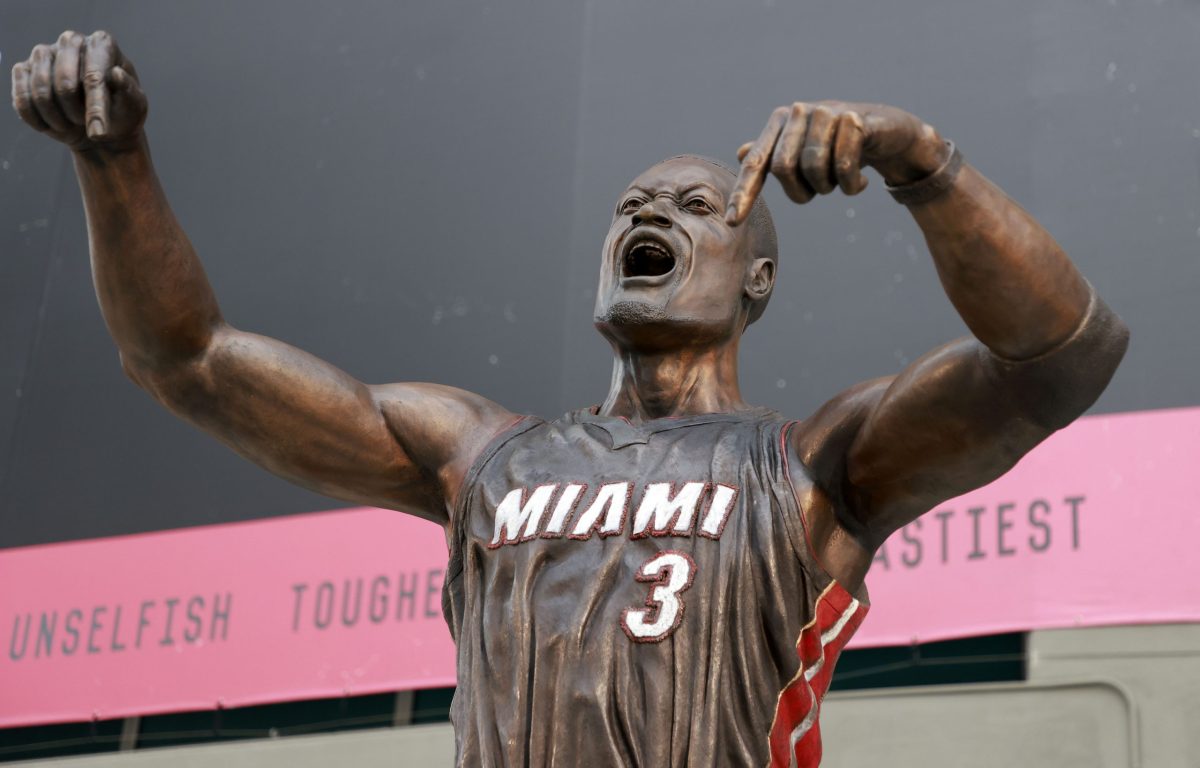
Dwyane Wade approved changes to the head of his statue outside the Miami Heat’s arena after reconsidering his initial response to criticism of its appearance.
The Heat shared the revised sculpture Friday, two years after the original was unveiled in 2024. In an essay titled “This Is My House,” Wade explained that his involvement in creating the original statue had made him protective of it.
Eventually, though, he began looking at the tribute from the perspective of the fans who visit it.
“But eventually, I had to take a step back and understand that the statue doesn’t belong only to me,” Wade wrote.
That realization helped lead to discussions about changing the face. Wade said everyone involved agreed to adjustments, with the goal of making the sculpture better convey both his appearance and the feeling behind the moment it commemorates.
The original sculptors spent several months working on the new head and face with Wade’s approval. The revised version remains outside Kaseya Center.
Dwyane Wade explains why he reconsidered his statue’s face
Wade acknowledged seeing the jokes, memes and other reactions that followed the unveiling. In his account, the discussion quickly centered on whether the sculpture resembled him.
His first instinct was shaped by an experience most of the people reacting to the statue had not shared. He had been involved in its creation and understood the effort that went into the entire piece.
That history gave him an attachment to the work before the public had its first opportunity to judge it. Wade described becoming more receptive to criticism once he considered how other people experience the statue.
For visitors, it can be a stop during a trip to a Heat game, a place for a family photograph or a connection to a player whose biggest moments they watched years earlier.
He also mentioned younger fans who were not alive for some of those moments. Their relationship to the sculpture is necessarily different from that of someone who watched him play, but he included them among the people the tribute should reach.
The photos and videos fans send him reinforced that point. Wade wrote that those interactions remind him that the statue has personal significance for people whose memories of his career differ from his own.
His explanation offers a reason for revisiting the face beyond the volume of online criticism: He wanted the people approaching the statue to recognize the feeling it was intended to preserve.
The Heat statue depicts a moment Wade had imagined for years
A new look at Dwyane Wade’s statue, which has been enhanced to better reflect his likeness 👀
(via @MiamiHEAT) pic.twitter.com/fjH8hvCLoJ
— Heat Nation (@HeatNationCom) October 30, 2026
The pose comes from Wade’s game-winning shot against Chicago on March 9, 2009, followed by his celebration on the scorer’s table. Revisiting the play in his essay, he explained why that particular night remained so meaningful to him.
Wade described the sequence as one of his most treasured basketball experiences, putting it near the top of his personal list outside championship victories. Facing Chicago gave the moment additional meaning because it was the city where he grew up.
“Outside of winning championships, it may be my favorite moment I ever had on a basketball court,” Wade wrote. “There was something poetic about being a kid from Chicago, playing against Chicago, hitting that shot in the fashion that I did, and then jumping on the scorer’s table in Miami.
“That jump was something I had dreamed about long before it happened.”
His essay also explains that the celebration had roots in his imagination long before that game. As a young fan, he watched players make decisive shots and climb onto the scorer’s table.
Later, during his time at Marquette, he pictured himself having a similar experience. Wade recalled being in the gym late at night with Zaire and imagining the winning basket, the jump onto the table and the response from the crowd.
The Chicago game eventually gave him the opportunity to experience the scene he had envisioned. The words that became associated with it were spontaneous, according to Wade.
He connected the declaration to the succession of events that had just unfolded: taking the ball away, getting the shot off and hearing the building react.
That distinction adds context to the statue’s expression. The pose memorializes an emotional response to a specific finish, one Wade says became an enduring part of his relationship with Miami.
Why the revised head mattered to Wade
Wade wrote that he wants the statue to bring people back to that feeling, whether they attended the game, watched it elsewhere or learned about it afterward.
For those who were in the arena, he hopes the sculpture can recall their own experience of the night.
He framed the decision to revise the face around a practical question.
“If people don’t feel that connection when they look at the face, why wouldn’t we try to make it better?” Wade wrote.
The second process had a narrower scope than the first. Wade said the work could concentrate on the head instead of requiring the creation of an entire sculpture.
He appreciated being able to focus on that part, while also making clear that he valued his participation in the original project. He also rejected the idea that returning to the work meant dismissing the artists’ effort.
His account describes a shared decision reached through conversations. That leaves the updated face as an adjustment to the existing tribute, with Wade involved in both versions of the process.
Heat share the updated tribute with fans
Miami published images of the statue’s enhancements Friday, pairing them with Wade’s message about the tribute’s shared meaning.
“It may be my likeness, but it will always be our house.” – @DwyaneWade
A closer look at the enhancements to his statue. pic.twitter.com/VmcBYsEzDK
— Miami HEAT (@MiamiHEAT) October 30, 2026
Wade described the statue as the first outside the arena and wrote about wanting Miami residents and Heat fans to take pride in it. He credited the crowd’s support as part of what made the original basketball moment possible.
For Wade, that connection remains present when he returns to the arena or the city. His stated hope for the revised sculpture is that visitors recognize him more clearly while also finding their own memories in the scene it captures.