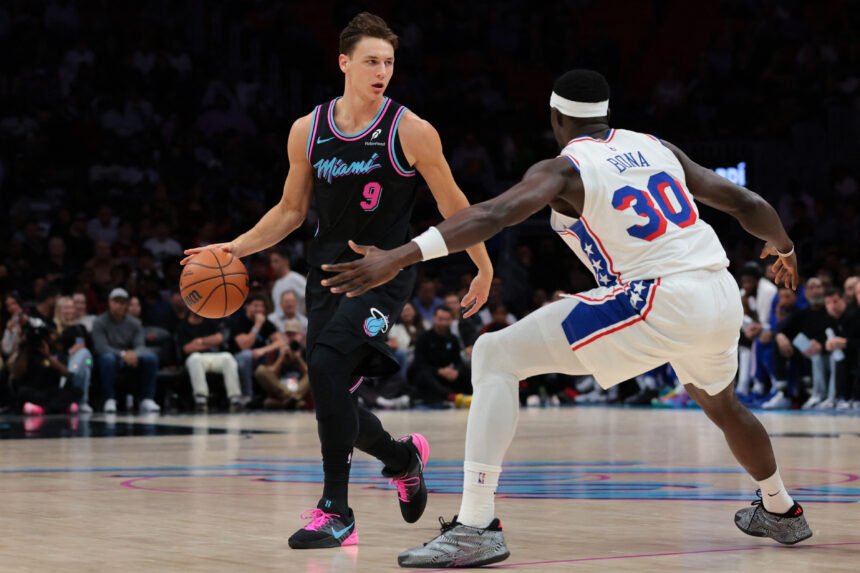
The Miami Heat’s agreement with Pelle Larsson comes with an immediate limit on their trade options.
Larsson is the only player on Miami’s roster who cannot be dealt during the upcoming season following his extension. That outcome is attributed to the timing and structure of the deal.
The development adds a roster-building consequence to the four-year, $60 million agreement Miami reached with Larsson. The Heat have committed to his future, and his availability in potential trades is now a separate consideration.
Why Pelle Larsson’s extension affects his trade eligibility
The NBA’s collective bargaining agreement imposes a six-month trade restriction on certain veteran extensions that exceed the limits permitted in an extend-and-trade transaction. Article VII, Section 8(f)(i) includes extensions covering five seasons when the remaining contract term is counted.
A September signing subject to that rule would keep a player unavailable through the Feb. 11, 2027, trade deadline. The restriction runs from the signing date, so the date an agreement is reported should not automatically be used to calculate the precise day it expires.
That distinction helps explain why a six-month restriction can effectively remove a player from an entire season’s trade market. The waiting period can end after teams have already lost the opportunity to make an in-season deal.
What the Heat have agreed to with Larsson
ESPN’s Shams Charania reported Friday that Larsson and Miami had reached terms on the extension, citing agents Austin Brown and Steven Heumann. Charania also reported a mutual option for the 2030-31 season.
Miami Heat guard Pelle Larsson has agreed to a new four-year, $60 million contract extension, with a mutual option for the 2030-31 season, Austin Brown and Steven Heumann of CAA Sports tell ESPN. pic.twitter.com/wVsi86w9yY
— Shams Charania (@ShamsCharania) September 18, 2026
Monday’s update shifts the focus from the size of that commitment to its immediate implications. An extension announcement answers how a team plans to retain a player; trade eligibility determines whether that same player can be included if another opportunity arises.
For Miami, the practical consequence is that any in-season trade construction would have to leave Larsson out. That matters when evaluating hypothetical deals, even without evidence that the Heat had considered moving him.
What this means for Miami’s roster decisions
The restriction should not be read as an announcement that Miami is shopping other players. Eligibility alone says nothing about a team’s willingness to trade someone or what another club would offer.
It does, however, narrow the discussion around Larsson. Evaluating his upcoming season can center on his contribution to Miami rather than treating his contract as an available piece in every proposed trade.
There is also a distinction between securing a player’s future and settling his basketball role. The extension does not establish a starting assignment, guarantee closing minutes or answer how large a role he will earn.
Those decisions still belong on the court. The new reporting addresses a different question: whether Miami can include Larsson in a deal while the season unfolds. It seems that option is off the table.