
Landing Giannis Antetokounmpo was the part Miami will remember. Keeping a roster around him is the part that will decide whether the trade works, and that job began before the confetti had a chance to settle.
Within hours of the Miami Heat agreeing to acquire the two-time MVP, a conference rival was already circling the one free agent Miami can least afford to lose.
The blockbuster for Antetokounmpo and Bobby Portis cost the Heat four rotation players and a stack of draft capital, and it left team president Pat Riley hard-capped at the first apron with a short bench and a long to-do list. The headline is settled. The math is not.
The first-apron squeeze
Because Miami used more than 100 percent of the traded player exception to absorb Antetokounmpo’s salary, the Heat are hard-capped at the first apron for next season, a roughly $209 million ceiling they cannot cross under any circumstance. Per ESPN’s Bobby Marks, Miami projects to sit about $18 million below that line with several roster spots to fill.
That is not much room for a team that has to rebuild most of a rotation. The hard cap also strips away Miami’s most useful tools, since the Heat cannot dip into the full non-taxpayer mid-level exception or lean on Bird rights if doing so would push them past the apron. The front office has to fill out a roster and chase shooting on a budget that the trade just shrank.
The Norman Powell problem
No player matters more to that math than Norman Powell. The veteran guard is coming off the finest season of his career, averaging 21.7 points, 3.5 rebounds and 2.5 assists per game while shooting 38.0 percent from 3-point range across 58 games, production that earned him his first All-Star selection. Next to Antetokounmpo and Bam Adebayo, neither of whom stretches the floor, Powell is the spacing that makes the new core function.
Keeping him is the hard part. Powell earned $20.5 million this past season, and at 33 he is looking for a raise rather than a discount on the heels of an All-Star year. Miami owns his Bird rights and can technically pay him whatever it wants, but the first-apron hard cap makes that freedom largely theoretical.
The reporting around the league reflects the bind. ESPN’s Brian Windhorst said Tuesday that Powell is not expected to re-sign with Miami barring a “crazy discount,” and Charania went further on the player’s standing in the new rotation.
“We can probably take Norman Powell off this starting five,” Charania said on “The Pat McAfee Show.”
The competition is already forming. According to Marc Stein and Jake Fischer of The Stein Line, the Detroit Pistons intend to add Powell to an offseason wish list as they hunt for shooting and playmaking around Cade Cunningham, a fit that makes Miami’s task harder and the stakes higher.
The price problem comes back to one teammate. If Andrew Wiggins picks up his player option and Miami cannot shed any other salary, the Heat’s offer to Powell would have to start at roughly $12 million to $13 million per year, according to the Miami Herald‘s Barry Jackson — well below what a first-time All-Star will command on the open market.
The Andrew Wiggins swing
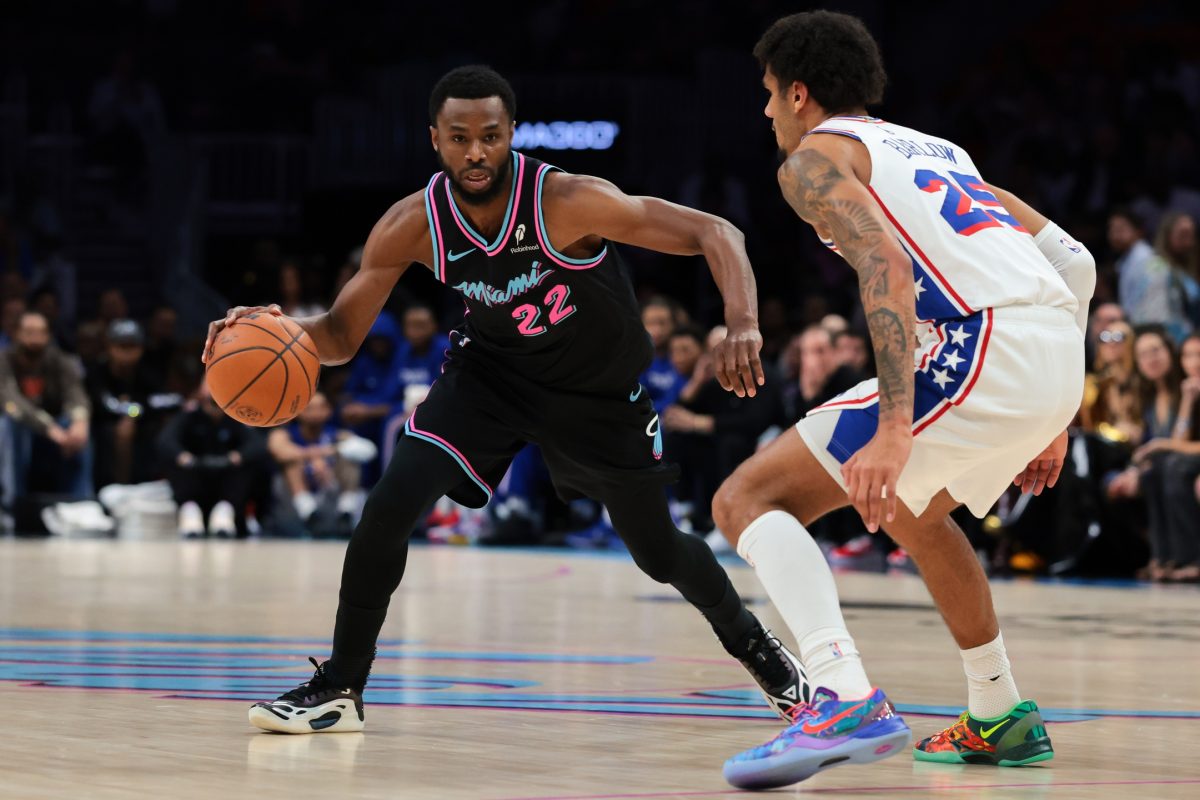
That makes Wiggins the swing vote of Miami’s offseason. He holds a $30.2 million player option for next season, and the straightforward expectation is that he picks it up, since opting out to chase a bigger number elsewhere carries real risk for a 31-year-old wing.
The more interesting path is the creative one. As Marks laid out, Wiggins could decline the option and re-sign at a lower starting salary spread across an extra guaranteed year, a move that would carve out meaningful space beneath the apron.
One example floated by ESPN would put Miami roughly $38 million under the first apron, enough to change the Powell calculus entirely. Wiggins matters on the floor as well, a connective two-way wing who shot around 40 percent from 3-point range and slots cleanly alongside the new starters. His decision, more than any other, determines how much of the supporting cast survives.
What the Heat actually need
Strip away the names and the need is simple: shooting, and someone to deliver the ball to the bigs. Trading Tyler Herro, a career 38.2 percent shooter from 3-point range, removed one of Miami’s primary creators and floor-spacers, and the bench behind the new starters is thin on both counts. Replenishing perimeter scoring on a minimum-salary budget is the unglamorous work that will define this roster.
Miami does have one more lever. Nikola Jovic has surfaced as a possible trade candidate, a young player the Heat could move to open additional room or bring back a more proven contributor. With few tradeable assets left after the Antetokounmpo deal, every remaining piece carries weight, and the front office will have to be precise rather than aggressive the rest of the way.
The extension that anchors it all
The reason the squeeze is worth enduring is the commitment waiting on the other side of it. Antetokounmpo becomes eligible to sign an extension as early as October, but the expectation is that he waits until Jan. 6, at which point he can sign a four-year, $275 million maximum extension if he declines his player option, or extend for three years and $214 million if he opts in. The Athletic has reported that he intends to sign once eligible.
That timeline is the whole point. Miami did not mortgage its future for a one-year rental, and the extension window gives both sides a clear path to making the partnership long-term. It also explains why the cap pressure is not a one-summer problem. Building a sustainable roster around two max-level bigs in the second-apron era will test the front office’s creativity for years, not weeks.
The bottom line
Riley got the superstar. The supporting cast is now the project, and it is a harder one than landing Antetokounmpo was. The Heat are thin, capped and short on the tools that usually let a contender patch holes in free agency, and the most important domino — Powell — may fall toward a rival before Miami can set its own price.
The next two weeks decide it. Tuesday’s draft, the July 6 execution of the trade and the opening of free agency all arrive in quick succession, and by the time they pass, Miami will know how much of the roster around its new star it managed to keep. The celebration was the easy night. The math starts now.