
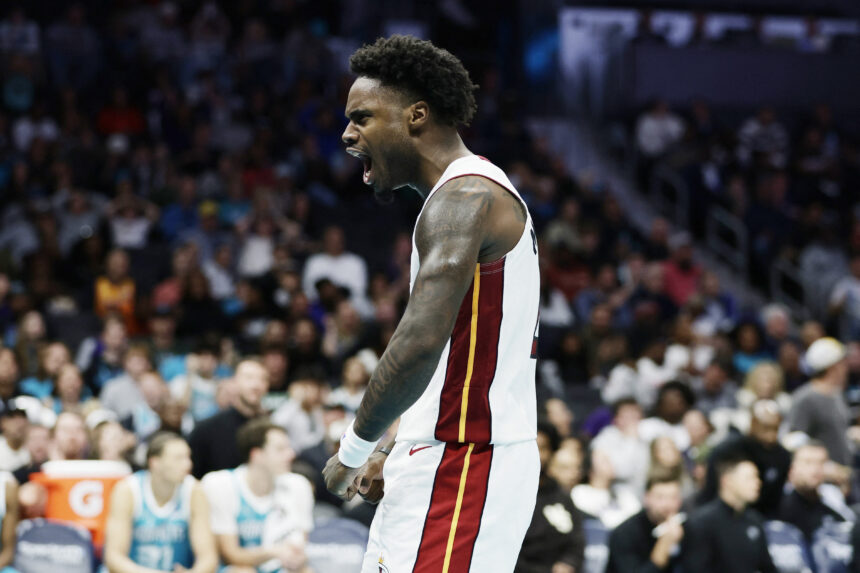
Davion Mitchell says the Miami Heat’s increased use of pick-and-rolls comes with an important qualification: Erik Spoelstra still wants an offense that moves quickly, rather than one that waits for a screen on every possession.
Mitchell explained how Miami is adding structure after its 0-4 start without abandoning the principles behind its offense. The Heat have won five of their next seven games, with a measurable increase in ball-screen activity accompanying that improvement.
“In a way, we’re still doing the same thing,” Mitchell said. “I think a lot of times people just see more pick-and-rolls, but that’s only on dead balls. I think we still have the same principles. … I don’t really look like we need a ball screen every single time because that’s not who our personnel is and I don’t think we’re going to win a lot of games like that. I think if we keep playing fast and if ball screens happen, we know how to adjust.”
That distinction gives the adjustment a more specific purpose. Mitchell described a team using stoppages to organize its attack while retaining the freedom to move quickly when play is flowing. His explanation does not suggest Miami wants every trip down the floor to begin with the same action.”
The Heat averaged 29.1 pick-and-rolls per 100 possessions in their first four games, then increased that figure to 38 over the next seven, citing Genius Sports tracking data. That is an increase of 8.9 per 100 possessions, or approximately 31 percent.
The difference is meaningful within Miami’s own offense, even though the Heat still rank last in on-ball screen usage. Spoelstra has increased the frequency of an action his team uses relatively sparingly; the numbers do not establish a wholesale conversion to a screen-heavy system.
More pick-and-rolls have not meant a slower Heat offense
The latest comparison also puts a limit on what can be concluded from the turnaround. Miami’s 5-2 stretch coincides with more pick-and-rolls, but the record alone cannot show how much credit belongs to that change. Personnel adjustments and defensive execution are part of the same evaluation.
Here is how the offensive indicators compare:
| Measure | Earlier period | Latest reported figure |
|---|---|---|
| Pick-and-rolls per 100 possessions | 29.1 in first four games | 38 in next seven games |
| Dribble handoffs per 100 possessions | 6 in 2025-26 | 12 in 2026-27 |
| Pace entering Thursday | Not compared here | 102.8 possessions per 48 minutes; third in NBA |
The pace figure is particularly useful when assessing what Spoelstra has changed. Miami entered Thursday third in the NBA at 102.8 possessions per 48 minutes. More organized possessions have therefore existed alongside one of the league’s fastest overall tempos.
Pace and play selection measure different things. A team’s possession count does not reveal whether its offense began with a called action, and a higher ball-screen rate does not by itself establish that players are taking longer to attack. Miami’s figures illustrate why those questions should be considered separately.
Spoelstra’s explanation centered on choosing where an offensive possession should go. He described the Heat as becoming more deliberate about initiating particular actions, with a pick-and-roll representing one option rather than the only solution.
Mitchell also cautioned against making ball screens the default on every trip. He said Miami’s personnel still need to play quickly and respond when those opportunities arise. For the point guard, adapting the offense means balancing those approaches instead of treating every possession alike.
There is an encouraging efficiency figure behind the experiment. Miami is generating 1.13 points per possession in pick-and-roll situations this season, second in the league to Houston in the cited tracking data. That ranking describes this season’s production, not a guarantee that increasing the volume further would produce the same return.
Klay Thompson gives Miami another way to create movement
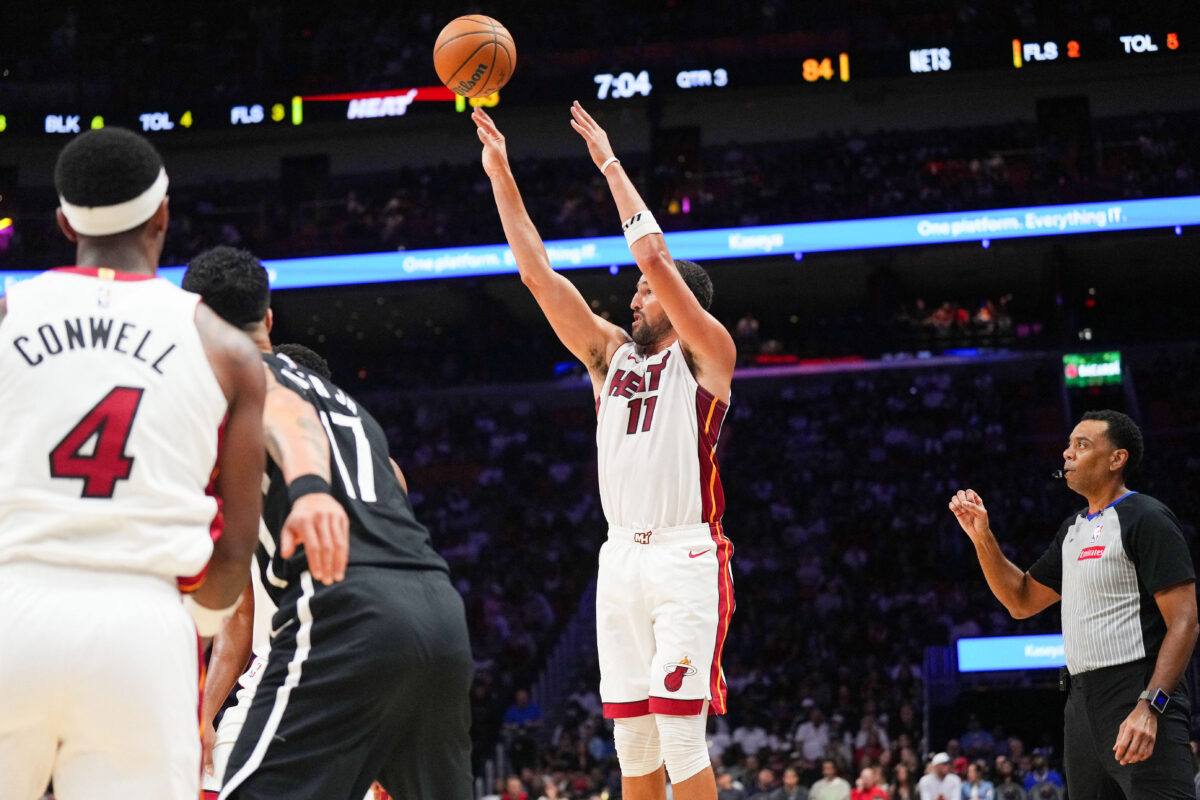
The increased use of dribble handoffs provides a separate example of Spoelstra adapting to the roster. According to the tracking figures, Miami is using 12 handoffs per 100 possessions this season, compared with six last season.
Thompson’s arrival helps explain that difference. His handoffs with Bam Adebayo and Giannis Antetokounmpo have been a way to create moving 3-point opportunities. That gives the Heat another means of involving their big men in an action that is designed to produce a perimeter shot.
The handoff comparison should not be confused with the pick-and-roll increase during the current season. One measures this season against last season; the other separates Miami’s first four games from its next seven.
Together, they show different layers of adjustment, but they cannot be combined into a single before-and-after test.
Miami has also changed who begins games. Pelle Larsson replaced Andrew Wiggins in the starting lineup for the last two outings, while Wiggins has discussed finding his offense in a reserve role.
That move creates another reason to be careful when attributing results solely to play calls. The Heat are evaluating a different opening group at the same time they are adjusting how they initiate offense. A better stretch from the team cannot isolate the effect of either decision.
Spoelstra still puts defensive effort first
Spoelstra has resisted describing the recent changes as a complete overhaul. In the Herald report, he emphasized that the defensive approach is largely about consistently delivering what Miami intended to establish before the season.
“There are certainly some adjustments we’ve made, but I wouldn’t say they’re monumental adjustments,” Spoelstra said. “It’s really been more about just really committing to our identity and doing it over and over and over.”
That emphasis matters for a team whose offensive decisions are attracting attention. The Heat have also used more switching and zone defense recently, but Spoelstra placed the standard of competition ahead of the particular coverage.
The changes are taking place on both ends, even if ball-screen usage offers the clearest numerical comparison in the report. Miami now takes a 5-6 record into a five-game homestand that begins Friday against Cleveland.
The next stage is sustaining the improvement while continuing to sort out which combinations and actions work together. Mitchell’s explanation gives that evaluation a useful starting point: watch when Miami calls for a screen, not simply how often.
The Heat are adding organization to selected possessions while still asking their players to make quick decisions in the flow of the game.