
Davion Mitchell failed the Miami Heat’s preseason conditioning test last year after becoming a father and taking an overnight flight back to join the team. Now, he says he is approaching the next season in a better place, both physically and mentally.
The Heat guard discussed the experience on “Deuce & Mo,” explaining how a difficult summer affected his preparation and how Erik Spoelstra helped him work through it. His account also included a clear offseason assignment from Pat Riley: return in better shape.
The episode was released Thursday evening in the United States. Mitchell explained that his daughter’s arrival had complicated the lead-up to camp.
“When I ran last year, I didn’t even pass,” Mitchell said. “I wasn’t even there [training at Kaseya Center in the weeks prior]. I just had a kid. I just had my daughter, and I literally had to get on a red eye and go to the gym. It was tough last year.”
That experience is part of the background to Mitchell’s preparations for a season in which he will play alongside Giannis Antetokounmpo. His comments describe a player trying to improve his own starting point while learning how he can contribute to a changed team.
Davion Mitchell explains the Heat’s conditioning test
According to Mitchell’s description, Miami requires five trips up the court within a minute, followed by two minutes of recovery. Players have to complete that sequence five times.
“It’s one of the hardest things I’ve done in my life,” Mitchell said. “You’ve got to run it in one minute and you only have a two-minute break. You have to do it five times.”
He contrasted that with a three-trip requirement he said was used by most teams and described Miami’s version as among the most difficult things he had done. That comparison reflects Mitchell’s experience, rather than an independently documented survey of every NBA team’s testing standards.
The repeated efforts were only one part of his difficulty. Mitchell said he had not spent the preceding weeks working at Kaseya Center, and the transition into fatherhood coincided with a period when he did not feel fully prepared for camp.
His explanation also distinguishes the failed attempt from his current outlook. He was recalling the previous preseason, not announcing that he had failed a new test this month. The interview did not establish a result for his next attempt.
For Miami, the practical question will be how his preparation carries into basketball. A timed running exercise can measure one aspect of readiness, but a guard also needs to sustain his effort while reading a defense, navigating screens and making decisions with the ball.
Those demands can overlap without being identical. Passing the test would address a preseason requirement; maintaining effective play through repeated possessions is the challenge that follows it.
Erik Spoelstra helped Mitchell regain confidence

Mitchell’s account of the summer extended beyond his conditioning. He said he was dealing with personal pressures that left him unusually withdrawn during camp and made it difficult to feel comfortable in his work.
In the same interview, he credited Spoelstra with recognizing what he was experiencing and continuing to give him opportunities. Mitchell said that trust helped him develop as a player at a time when his own confidence was difficult to sustain.
“I respected [Spoelstra] because he put me out there and made me grow as a player,” Mitchell said. “He really believed in me. I was going through so much mentally, it was hard to have confidence in everything I was doing. It wasn’t basketball; it was life. People don’t understand we’re still human.”
The distinction is meaningful in a story that begins with an unsuccessful workout. Mitchell did not describe his relationship with Spoelstra only in terms of whether he met a fitness requirement.
He also described a coach who understood his circumstances and remained willing to put him on the floor. That does not mean the expectations disappeared.
His account of Miami’s response includes both support during a difficult stretch and a direct request for improvement once the season ended. For a guard, those two parts of a coaching relationship can matter together.
Confidence helps a player make a decision without hesitating, while accountability provides a reason to evaluate whether that decision was the right one. Neither is a substitute for the preparation needed to execute it.
Mitchell’s comments offer his perspective on how that balance worked in Miami. They also provide context for why he believes the upcoming season can begin differently.
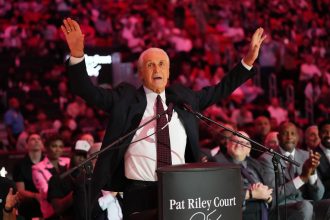
Pat Riley made conditioning an offseason priority
At his exit meeting, Mitchell said, Riley and Spoelstra concentrated on his weight and fitness instead of giving him a list of basketball adjustments. Riley acknowledged the circumstances surrounding the previous year while making clear that Mitchell needed to return closer to the team’s expectations.
Mitchell said he had responded by losing weight and playing basketball regularly throughout the summer.
“This season is going to be so much different,” Mitchell said. “Mentally, I’m so much sharper. Physically I’m so much sharper.”
His assessment is encouraging for Miami, although it remains his own evaluation before the season. The more useful evidence will come from whether he can sustain his pace, respond to different assignments and maintain his effectiveness as games develop.
Mitchell averaged 9.3 points and 6.5 assists per game last season. Improving on his contribution will not necessarily require a dramatic increase in either number.
A quicker decision that gets a teammate an advantage, a defensive recovery that keeps a possession intact or a productive stretch late in a game could all matter without producing an obvious change in his scoring average. Those are practical areas to watch as his preparation is tested on the court.
Giannis gives Mitchell another reason for optimism
Miami acquired Antetokounmpo from Milwaukee this offseason, and Mitchell has already spent time with him in Greece. Mitchell said their interactions gave him a greater appreciation for Antetokounmpo’s competitive approach, including away from basketball.
The personal connection fits into the offseason time Miami’s rebuilt roster has spent together. Familiarity can provide a starting point, but the on-court relationships will still need to develop through practices and games.
Mitchell was particularly enthusiastic about the defensive combinations available with Antetokounmpo, Bam Adebayo and Andrew Wiggins. He described the possibility of pressuring an opponent farther from the basket with confidence that a teammate could provide help if he was beaten.
He also outlined how he and Wiggins could take different types of assignments, with Mitchell handling quicker guards and Wiggins matching up against larger players. Those were his descriptions of the possibilities, rather than an announced defensive plan from Spoelstra.
Making that approach work would require more than individual ability. If Mitchell applies pressure well above the 3-point line, the players behind him must communicate, position themselves to help and recover when the offense moves the ball.
Greater aggression can create opportunities, but it also asks the rest of the defense to react together.
That is where Mitchell’s conditioning goals and his enthusiasm for the roster meet. The group could give him opportunities to defend assertively, while his own preparation will help determine how consistently he can carry out that work.