
The question Heat fans spent the weekend asking got its answer Monday, and it came from Boston. Devin Carter, the former No. 13 pick whose father spent four seasons in a Miami uniform, has agreed to join the Celtics, with Carter set to compete in camp for either a standard roster spot or a two-way slot.
The Boston Celtics and Devin Carter have agreed to a deal, league sources told @hoopshype. Carter will compete for an NBA roster or two-way spot in camp. Carter averaged 8.9 points, 3.3 rebounds and 2.7 assists in 18.4 minutes during 38 games for the Sacramento Kings last season. pic.twitter.com/eo4U82bCg2
— Michael Scotto (@MikeAScotto) September 14, 2026
The structure of the deal is the detail that changes how the Heat side of this story should be read. The agreement is an Exhibit 10 contract, which means Carter has a camp invitation rather than a guaranteed job.
Miami, which entered the weekend with one open standard roster spot, stood pat. That’s because some are saying the Heat may have more belief in Tre Donaldson.
Which might mean the Heat had more belief in Tre Donaldson. https://t.co/SAlkaDT2Ed
— Ira Winderman (@IraHeatBeat) September 14, 2026
What an Exhibit 10 deal actually is, and why it matters here
An Exhibit 10 contract is a one-year, non-guaranteed minimum deal that gives a team a look at a player in training camp with almost no downside. If the player is cut, he can collect a bonus for reporting to the team’s G League affiliate, and the deal can also be converted into a two-way contract before the season.
That is exactly Carter’s arrangement. The contract becomes a standard non-guaranteed deal if Carter makes Boston’s regular-season roster, can be flipped to a two-way, or otherwise pays Carter a bonus for joining the Maine Celtics.
In other words, Boston did not commit its 15th roster spot to Carter. It committed a camp jersey and a chance, which is the lowest-cost way any team can evaluate a 24-year-old whose first two seasons were interrupted by shoulder, ankle, back and calf issues.
Carter averaged 8.9 points, 3.3 rebounds and 2.7 assists per game in 18.4 minutes across 38 games for Sacramento last season. The Kings moved him to Atlanta in late June, and the Hawks waived him Sept. 11 without playing him in a regular-season game.
Ira Winderman’s read: a vote for Tre Donaldson
Winderman was the voice who made the Heat angle legitimate in the first place. In his Sept. 12 mailbag, he agreed that signing Carter would be a classic Heat move given the franchise’s habit of bringing in the sons of former players and staffers, then flagged the medical history and recommended prudence near the hard cap.
His Monday reaction narrowed the interpretation. By tying the non-move to Donaldson, Winderman pointed at the player already occupying the role Carter would have been competing for: a young, defense-first guard developing behind Davion Mitchell.
That framing deserves the same precision Heat Nation applied before the weekend. No reporter has said the Heat made Carter an offer that he turned down, and no reporter has said the front office declined to make one.
Winderman’s language was “might mean,” and the sentence should be read at that level.
Who Tre Donaldson is
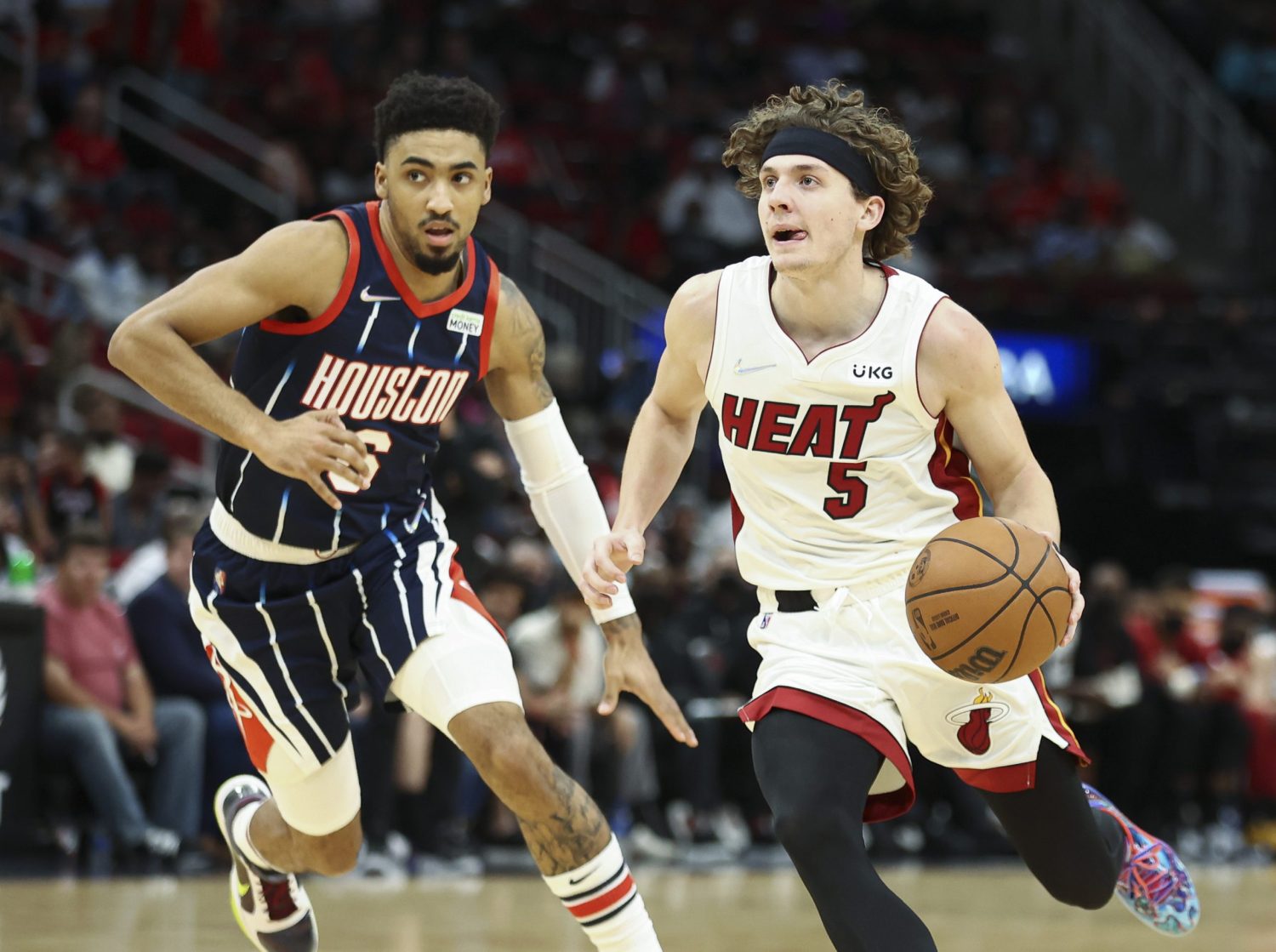
Donaldson is a 22-year-old guard, listed at 6-foot-3 and 195 pounds by Basketball-Reference, who played his final college season at the University of Miami after stops at Auburn and Michigan. He went undrafted in June and signed a two-way contract with the Heat immediately afterward.
His one season with the Hurricanes produced 16.4 points, 5.7 assists and 3.6 rebounds per game on 45.4 percent shooting, along with second-team All-ACC honors. In Las Vegas Summer League, he averaged 16.3 points, 4.5 rebounds, 6.8 assists and 1.8 steals per game over four games while hitting 43.8 percent from three.
The comparison to Carter is not one-for-one. Carter is two years older, has 74 NBA games behind him and was a lottery pick, while Donaldson has yet to play a regular-season minute.
What they share is the profile Miami has repeatedly built its bench from: a point-of-attack defender who can handle the ball and needs to prove the shot.
Donaldson also carries the developmental advantages that Carter, on an Exhibit 10 in Boston, does not. He is already inside the program, already on a two-way that allows up to 50 regular-season appearances and already has a Summer League on tape with the coaching staff that will run camp.
The Heat still have three roster levers
Standing pat on Carter does not mean the roster is finished, and Winderman laid out the mechanics in Monday’s mailbag.
Miami can add a 15th player right now without a corresponding move and without running into its hard cap. Beyond that open spot, the Heat could sign someone in place of Nick Richards, whose deal is non-guaranteed, and could sign someone in place of Myron Gardner, who carries a $500,000 guarantee, in December.
That gives the front office three swappable spots between now and midseason. The catch is the same one that has hovered over the 15th spot all summer: The swaps only make sense if there is a player worth swapping for.
Winderman’s expectation is that Miami will “bank that cash to see what develops on the buyout market,” which is a different priority than filling the roster before camp. A reclamation project on a minimum deal uses the room; an open spot preserves it for a rotation player who shakes loose in February.
Read alongside the Donaldson comment, the picture is consistent. The Heat appear comfortable with Mitchell, Dru Smith and a two-way rookie as the point-guard depth chart into camp, and would rather keep their flexibility for a bigger name than spend it on a camp flyer.
What Boston is getting
The Celtics are taking the kind of low-risk look Miami has historically taken with undrafted and discarded guards. Carter was Big East Player of the Year at Providence before the Kings drafted him, and the defensive instincts and rebounding that earned that draft slot have not gone anywhere.
The shooting is the reason he is on an Exhibit 10 rather than a guaranteed deal. His career field-goal and three-point percentages were the central concern in the Heat Nation breakdown from Sunday, and they would have been a fit problem on a floor built around Giannis Antetokounmpo and Bam Adebayo attacking the paint.
Boston will let Carter compete against its own Summer League holdovers for one of two open spots, and he will have a training camp to show a staff that no longer has him under the injury cloud that followed him in Sacramento.
What happens next
Heat training camp opens later this month, and the roster that spent last week bonding ahead of camp will report with the 15th spot still open. Donaldson will be in that camp on a two-way, with a chance to justify the belief Winderman described.
The remaining free-agent guards Heat fans have floated, from Gabe Vincent to D’Angelo Russell, are still available for a minimum, and Winderman’s mailbag confirmed the mechanism to sign one exists. Whether the Heat use it is the open question, and Monday suggested the answer is not yet.
For Carter, the family connection to Miami was real, and it was never going to be the deciding factor. The Celtics offered a tryout, and the Heat, by all available accounts, are content to let the tryout they already have on the roster play out first.