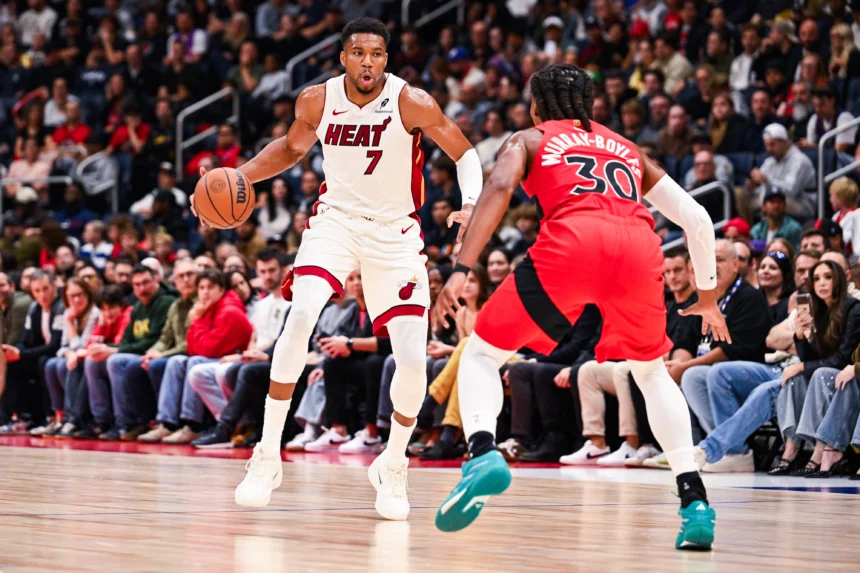
Erik Spoelstra needed only one preseason game with Giannis Antetokounmpo to reach for a comparison to Magic Johnson, and the Miami Heat coach had a specific reason for invoking the Los Angeles Lakers legend.
It was Antetokounmpo’s passing that caught his attention after Miami’s 129-105 win over the Toronto Raptors on Saturday in Quebec City. He finished with nine points, four rebounds and seven assists in 14 minutes, making all three field-goal attempts.
Spoelstra pointed to Antetokounmpo’s combination of size, vision and accuracy, explaining that a week of seeing him work at close range had deepened his appreciation of those skills. He also noted that Heat president Pat Riley had been watching practice.
“With the size and the vision and his ability to put it on the numbers to shooters is really impressive” said Spoelstra. “Pat [Riley] was at practice all week, and the way he’s played with the ball in his hands and delivering the ball, he reminds all of us of a great big point guard that played or Pat back in the 80s.”
The reference was to Johnson. For Miami, the immediate significance was how often Antetokounmpo’s decisions created scoring opportunities for the players around him, even on a night when he took very few shots himself.
Seven Giannis assists produced seven Heat 3-pointers
The NBA’s official game record shows that every Antetokounmpo assist led to a made three. Andrew Wiggins converted four of those passes, while Bam Adebayo, Davion Mitchell and Tim Hardaway Jr. each supplied one basket.
That means the seven assisted shots generated 21 points. Add Antetokounmpo’s nine points, and he either scored or supplied the credited assist on 30 Miami points.
That calculation captures why his individual scoring total alone gives an incomplete picture of the debut. The connections developed across both quarters.
Wiggins made two Giannis-assisted threes in the first period and two more in the second. Adebayo and Mitchell were the other first-quarter recipients, while Hardaway converted the final assist with 4:33 remaining before halftime.
Those details also keep the description of his passing precise. The official play-by-play identifies Mitchell’s basket and Hardaway’s basket as step-back threes; the seven assists should not all be described as identical catch-and-shoot possessions.
The common result was a three-point basket after an Antetokounmpo pass. Wiggins offered a direct explanation of what it felt like to play alongside him.
“Giannis, his gravitational pull in that paint, it’s crazy,” Wiggins said.
For the Heat, that is the practical value behind the comparison. Antetokounmpo can threaten the basket and still move the possession toward a teammate when the defense commits extra attention to him.
Miami’s perimeter players then have to turn that opening into a productive shot.
Why Spoelstra’s Magic Johnson reference carries weight

Riley coached the Lakers to four championships during the 1980s, winning titles in 1982, 1985, 1987 and 1988. Johnson, a 6-foot-9 point guard who averaged 11.2 assists per game over his NBA career, was central to that era.
Spoelstra’s reference connected the passing he has been watching in Miami to a player Riley once coached. It was a comparison of particular skills, with size and the ability to deliver the ball to teammates at the center of his explanation.
The wording matters. Spoelstra invoked Johnson without naming him in that passage, and he did not declare that Miami had become a new version of the Showtime Lakers.
Reading the comment as a description of Antetokounmpo’s playmaking keeps the praise attached to what the coach actually discussed.
It also helps explain why a modest scoring night could produce such an enthusiastic response. A star’s impact on an offense includes the opportunities he creates before someone else finishes the possession.
Saturday supplied several clear examples of that contribution.
Miami’s shooting questions get an early test
Spoelstra had already responded to questions about the Heat’s shooting and roster construction at media day. Saturday supplied the first game evidence for evaluating how those pieces work together.
Miami made 11 of its 23 three-point attempts before halftime, or 47.8 percent, and scored 76 first-half points. Antetokounmpo’s seven assists accounted for seven of those 11 made threes.
The shooting success came with Klay Thompson starting alongside Mitchell, Wiggins, Antetokounmpo and Adebayo.
Thompson finished scoreless on two field-goal attempts. Hardaway, meanwhile, made all four of his shots off the bench, including three threes.
Those results show that Miami’s production on this particular night was distributed beyond the most obvious shooting name in its starting lineup.
They do not settle how consistently the Heat will shoot over a full season. The useful early evidence is that Antetokounmpo found multiple teammates for perimeter baskets, while the make-or-miss results still came from a very small preseason sample.
There is also a distinction between the team’s first-half scoring and the performance of its opening five. The starters outscored Toronto 34-29 during their shared minutes.
Miami’s full halftime advantage therefore should not be presented as something that lineup produced by itself.
Giannis is still learning his new teammates
The passing display followed a candid account of the adjustment process. After Wednesday’s practice, Antetokounmpo described throwing a pass out of bounds because a teammate moved somewhere other than where he expected.
His explanation focused on learning Miami’s spacing and movement. Saturday’s completed passes represent progress in game action, but they do not mean those new habits are fully established.
Anticipating a teammate’s location remains part of the work as the group spends more time together. Miami also had 25 turnovers in the win.
That team total includes the second half, when the starters were held out, so it should not be treated as a measure of how often the opening lineup made mistakes. It does give Spoelstra something concrete to address beyond the positive highlights.
Toronto played without Kawhi Leonard, another reason to keep the result in its preseason setting. Spoelstra described the outing as an opportunity to get his available players acclimated.
Miami’s next preseason game is Thursday against the New Orleans Pelicans. That gives Spoelstra another opportunity to evaluate the passing connections that prompted his Johnson comparison while working to reduce the possessions that end without a shot.