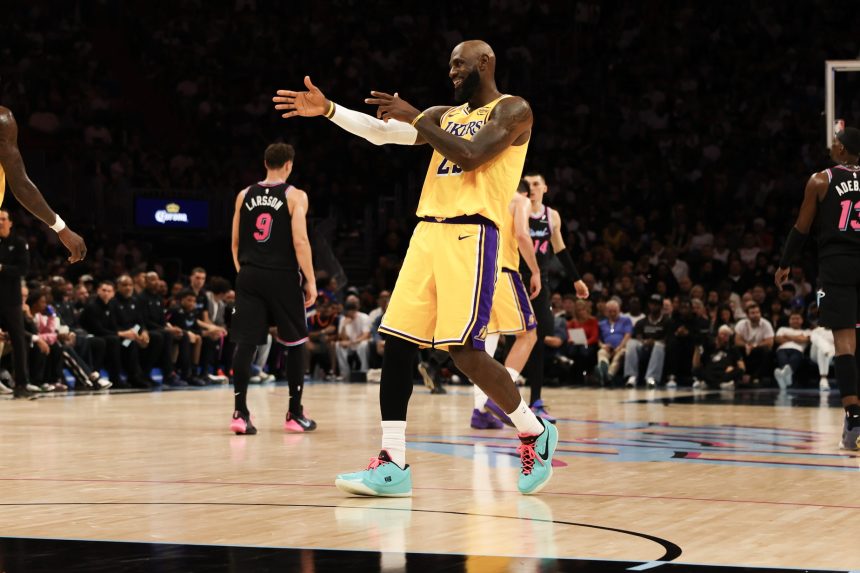
The Miami Heat already pulled off the move that defined their offseason. Whether they have a second one in them is suddenly a real question.
Days after landing Giannis Antetokounmpo from the Milwaukee Bucks, Miami keeps turning up in the same sentence as the biggest name left on the board: LeBron James. The idea reads like fantasy, and it mostly is. But the cap math behind it is worth taking seriously, because it explains both why the Heat can dream and why the dream is so hard to actually pull off.
The reporting that started it comes from Barry Jackson of the Miami Herald, who wrote that Miami could try to lure James with its full mid-level exception while cautioning that a return is a long shot, “though nothing can be ruled out.” That is the entire story in one line: a real mechanism, with a heavy dose of skepticism attached.
Why the conversation is happening now
Two things shifted this week. The first is Giannis. Pairing James with Antetokounmpo and Bam Adebayo under Erik Spoelstra would, on paper, hand Miami a contending core overnight, and that kind of fit is exactly what has pulled James toward a team late in his career.
The second is what is happening, or not happening, in Los Angeles. ESPN’s Shams Charania reported on “Get Up” that the Lakers had not made James an offer as of Friday, with little communication between the sides since an initial check-in call, because the front office wants to sort its roster and roughly $50 million in spending power before circling back to him.
Lakers reporter Jovan Buha, speaking on “The Herd,” put the risk plainly: If Los Angeles hands a big contract to a center after already paying Austin Reaves, he is not sure how that would sit with James. None of that is a report that James wants out. It is a crack in a door that looked shut a week ago, and for a Heat team with a new title window, a crack is enough to start asking questions.
The only number Miami can realistically offer
Here is where the romance meets the collective bargaining agreement. Miami sent out a haul of young players and draft capital to get Antetokounmpo, including Tyler Herro, Kel’el Ware and Jaime Jaquez Jr. among other pieces, and that came at the cost of both depth and flexibility.
The Heat do not have cap space to chase James. What they have is the full non-taxpayer mid-level exception, worth roughly $15.5 million. For a player who earned $52.6 million last season, that is a steep cut by any measure.
There is one wrinkle that makes Miami’s number stretch further than it looks: Florida has no state income tax, so a $15 million salary in Miami takes home meaningfully more than the same figure in California. That does not erase the gap to what the Lakers can pay using James’ Bird rights, but it narrows it. And for a player chasing a title more than a paycheck at this stage, the roster around him matters more than the after-tax math anyway.
The Norman Powell problem

The catch is the part most of the dream scenarios skip. Offering James the full mid-level exception would hard-cap the Heat at the first apron, and Jackson reported that doing so would leave no room to re-sign Norman Powell under that hard cap.
Powell is a restricted free agent and precisely the kind of floor-spacing shooter a Giannis-Adebayo frontcourt needs, which makes him difficult to simply let walk.
Jackson laid out the contortions required to keep both. One version has Andrew Wiggins opting out of his deal and re-signing on a three-year contract worth around $65 million, with Powell landing in the $12 million to $13 million range, to make a James addition fit.
Another involves moving Nikola Jovic to clear money so Miami can pay Powell closer to his market value. Every one of those paths asks multiple players to take less or be moved, which is why “long shot” keeps appearing next to this idea. The Heat need shooting to make their new core work, and signing James the simplest way directly threatens their best returning source of it.
The sign-and-trade alternative
If James wants more than the mid-level, the mechanism changes entirely. Because he is an unrestricted free agent who can be moved by Los Angeles, a sign-and-trade is the only way Miami pays him north of the exception, sending salary back to the Lakers, most logically Wiggins, in exchange for James on a new deal.
That route would let James earn closer to $20 million per year, but it tightens Miami’s hard-cap situation further and requires the Lakers to actually want Wiggins, which is its own question given how aggressively Los Angeles is hunting a center.
The cleanest version of this for Miami is the one where James decides the basketball is worth the discount and signs for the mid-level. The cleanest version for James’ bank account is the one that needs a third party to cooperate. Those two cleanest versions are not the same, and the distance between them is most of why this stays speculative.
What LeBron brings, and the real odds
The fit is not in question. James averaged 20.9 points, 7.2 assists, 6.1 rebounds and 1.2 steals per game across 60 games last season and slid into a third-option role for the Lakers without much friction down the stretch. A passer of his caliber next to two play-finishers like Antetokounmpo and Adebayo is the kind of pairing that wins playoff series, even with James at 41.
Spacing would be the obvious concern, since three non-shooters in the frontcourt is a genuine problem, but the raw talent is overwhelming.
The odds are the issue, not the vision. James can make more money in Los Angeles, his family is settled there, and if he does leave, a storybook return to Cleveland or a run alongside Stephen Curry in Golden State are also in the conversation. Miami’s pitch is the roster and the tax math, not the dollars, and that pitch only matters if talks in Los Angeles stall the way they briefly appeared to this week.
For now, the honest read is the one Jackson gave it from the start: a scenario worth monitoring, not a deal worth expecting. The Heat earned the right to dream big the moment they traded for Giannis Antetokounmpo. Turning that into a second superstar is a different kind of hard, and the cap sheet is the reason why.