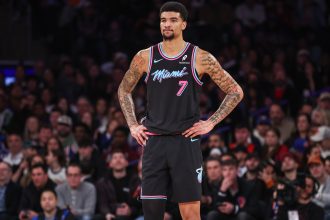

Bam Adebayo has not forgotten the play involving LaMelo Ball that preceded the end of the Miami Heat’s season. With another meeting approaching, he is also making clear that he does not intend to spend the new season consumed by it.
Adebayo addressed Ball ahead of Saturday’s preseason game against the Minnesota Timberwolves at Kaseya Center. Ball joined Minnesota during the offseason.
“I don’t carry hate in my heart,” Adebayo said. “If you spend that much time thinking about that, then you’re not worried about the present and the future.
“It happened, and it’s over with.”
He also explained the distinction between moving forward and erasing the memory of what happened.
“It’s one of those things where you forgive — and you don’t forget,” Adebayo said.
Those comments leave room for a conversation without promising a confrontation. Neither player’s participation in the exhibition was guaranteed, so the scheduled meeting should not be confused with a confirmed on-court matchup.
What the NBA decided after the LaMelo Ball incident
The NBA’s April 15 disciplinary announcement established that Ball’s contact with Adebayo warranted a flagrant-2 foul. The league assessed that penalty after reviewing the incident and fined Ball $35,000.
The play occurred with 11:13 remaining in the second quarter of Charlotte’s April 14 play-in game against Miami. Charlotte ultimately won 127-126 in overtime, ending the Heat’s season.
The play where Bam Adebayo got taken out. LaMelo Ball was complaining to the referees afterward. pic.twitter.com/xbKAhslFHB
— Tim Reynolds (@ByTimReynolds) April 15, 2026
The league described the contact as unnecessary and reckless, citing the risk of injury. That finding gives the discussion a concrete starting point: this was conduct the NBA determined deserved a serious penalty, even though officials had not stopped the game for it.
Ball also received a separate $25,000 fine for profanity during a live television interview after the game. That distinction matters when revisiting the punishment. The two fines totaled $60,000, but the entire amount was not imposed for the Adebayo incident.
Ball avoided a suspension and remained in the game after the uncalled play. Adebayo left with a back injury, while Ball later scored the winning layup with 4.7 seconds remaining in overtime.
For Miami, that sequence was especially consequential. The player responsible for the contact was available for the deciding possession; the player who went down was not.
The subsequent penalty acknowledged the offense, but it could not restore Adebayo to that game or change the result.
Why the play was not reviewed during the game
The officiating explanation is recorded in the April 14 pool report with crew chief Zach Zarba. Charlotte Observer reporter Rod Boone asked why officials had not reviewed the incident in real time.
Zarba explained that no whistle was blown and a fast break followed. By the time play stopped, possession had changed and a timeout had occurred, putting the incident outside the available review window under the rule he described.
“We reviewed the play at halftime,” Zarba said.
Asked whether it should have qualified as a flagrant foul, Zarba left that determination to league operations. The NBA’s disciplinary announcement arrived the following day.
That chronology separates two questions that can become tangled together: whether the contact deserved a flagrant penalty and whether officials could revisit it at the later stoppage.
The league’s eventual ruling answered the first question. Zarba’s explanation addressed the procedural obstacle to doing it during the game.
It also explains why a later review did not produce an in-game remedy for the Heat. The officials’ halftime examination and the league’s subsequent punishment were different steps, neither of which put the teams back at the moment when the incident occurred.
LaMelo Ball previously described trying to apologize
Ball discussed the aftermath before Charlotte’s April 17 play-in game against Orlando. Ball said he had tried to speak with Adebayo outside Miami’s locker room after the loss.
According to Ball’s account, security told him Adebayo was showering. He said he decided to give Adebayo space following the defeat, while emphasizing that he wanted to know the Heat center was OK.
“We don’t want nobody hurt in this league ever,” Ball said.
Those were Ball’s comments in April. Adebayo had said at his exit interview that he had not heard from Ball.
The distinction matters because an attempt to arrange an apology and a completed conversation are separate things. Ball described his effort to reach Adebayo; that account did not establish that the two had actually spoken.
Adebayo’s latest remarks should not be used to invent a private resolution that neither account documents.
The Heat enter the next meeting with a different outlook
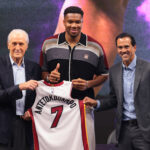
Miami’s summer has also changed the context. The Giannis Antetokounmpo trade included the Heat’s No. 13 draft selection in the package sent to Milwaukee.
That connection does not establish that losing was necessary for Miami to improve, or that the injury was somehow beneficial. A later transaction can create a positive outcome without making the original incident acceptable.
The immediate basketball task is building the new team. Spoelstra has already highlighted Antetokounmpo’s passing in his comparison to Magic Johnson.
That is a different discussion from the April controversy, but it shows where Miami’s preseason work is directed: learning how its new centerpiece creates opportunities for teammates.
The teams will meet again in their Oct. 21 regular-season opener at Kaseya Center. The exhibition therefore is not the only immediate occasion for the subject to resurface, particularly if either player sits out Saturday.
Adebayo indicated that he and Ball would probably talk. For Adebayo, the next encounter with Ball brings that future into contact with an unresolved memory.
His stated approach allows him to remember the play’s seriousness while keeping his attention on the Heat’s next season.